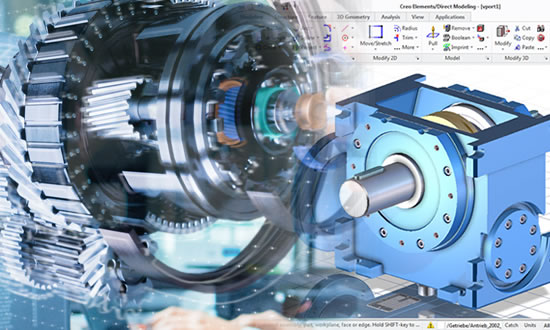
Pro/ENGINEER, launched in 1987, was among the first CAD programs to use parametric modeling, revolutionizing the way engineers designed products. Its transition to Creo in 2010 marked a significant upgrade, introducing a suite of scalable, interoperable, and open solutions. Creo's modularity allows companies to purchase the exact functionality they need, ensuring cost-effectiveness and flexibility.
Parametric and Direct Modeling:
Creo offers both parametric and direct modeling capabilities. Parametric modeling is ideal for detailed, constraint-driven designs, while direct modeling provides the flexibility to quickly make changes without the need to edit constraints.
Advanced Assembly Design:
Creo excels in handling complex assemblies, ensuring that all components fit together seamlessly. The software can manage large assemblies efficiently, which is crucial for industries like automotive and aerospace.
Simulation and Analysis:
With integrated simulation tools, engineers can perform stress analysis, thermal analysis, and motion analysis directly within the design environment. This integration reduces the need for multiple software tools and streamlines the product development process.
Additive Manufacturing:
Creo supports the latest advancements in additive manufacturing (3D printing). It allows for the design and optimization of parts specifically for 3D printing, including lattice structures and support generation.
Augmented Reality (AR):
One of Creo’s standout features is its built-in AR capabilities. Engineers can create AR experiences of their models to visualize and interact with them in a real-world context, enhancing collaboration and understanding among stakeholders.
Comprehensive CAD Data Management:
Creo integrates seamlessly with PTC’s Windchill, a PLM (Product Lifecycle Management) solution, ensuring robust data management, version control, and collaboration across global teams.
Why Engineers Choose Creo
Versatility: Creo's broad range of tools makes it suitable for various industries, from consumer electronics to heavy machinery.
Scalability: The modular approach means businesses can scale their use of Creo as their needs grow.
Innovation: Continuous updates and the incorporation of cutting-edge technologies keep Creo at the forefront of CAD and CAE software.
User Community and Support: PTC provides extensive support and resources, and the global community of Creo users is active in sharing knowledge and best practices.
Real-World Applications
Automotive Industry: Companies like Ford and GM use Creo for designing components and assemblies, ensuring precision and efficiency in their production lines.
Aerospace: Boeing and Lockheed Martin rely on Creo for its robust simulation capabilities and handling of complex assemblies.
Medical Devices: Creo helps in designing intricate medical devices that require high precision and adherence to strict regulatory standards.
Learning and Mastering Creo
For engineers new to Creo, numerous resources are available:
PTC University: Offers comprehensive courses and certifications.
Online Tutorials and Forums: Platforms like YouTube, Reddit, and dedicated CAD forums provide tutorials and user discussions.
Books and Guides: There are many books available that cover the basics to advanced topics in Creo.
Conclusion
Creo stands as a testament to the evolution of CAD software, providing engineers with powerful tools to design, analyze, and innovate. Its combination of parametric and direct modeling, along with advanced simulation, additive manufacturing, and AR capabilities, makes it an indispensable tool in modern engineering. As industries continue to evolve, Creo’s ability to adapt and incorporate new technologies ensures it will remain a cornerstone in the design and engineering world.
CANTER CADD being ISO 9001:2015 certified, the best CAD training institute can make a candidate’s profile strong and eligible to grab the trending jobs in the market. Moreover, the courses are offered by highly skilled and trained professionals to offer valuable knowledge to the candidates.
Locate CANTER CADD – The Best ansys Training Institute in Hyderabad-Mehdipatnam-Ameerpet-Himayatnagar-Dilsukhnagar-Habsiguda-Boduppal-ECIL-Santoshnagar-Chandanagar-Alwal-Kukatpally-Secunderabad-Warangal-Hanamkonda, Bangalore-Marathahalli-BTMLayout-Electronic City-Yelahanka-Banashankari-JPNagar-Srinagar-Hulimavu-Chamrajpet-Horamavu-Vidyaranyapuram, Andhra Pradesh-Guntur-Nellore-Kurnool-Rajahmundry-Tirupati-Dwarakanagar-Vizag-Vijayawada, Delhi NCR-LaxmiNagar-RajendraPlace-Rohini-Adhchini-Kalu-Sarai-, Pune-Akurdi, Tamil Nadu-Coimbatore, Uttar Pradesh--Gazhiabad-Meerut, Kerala, , Mumbai, Nagpur.