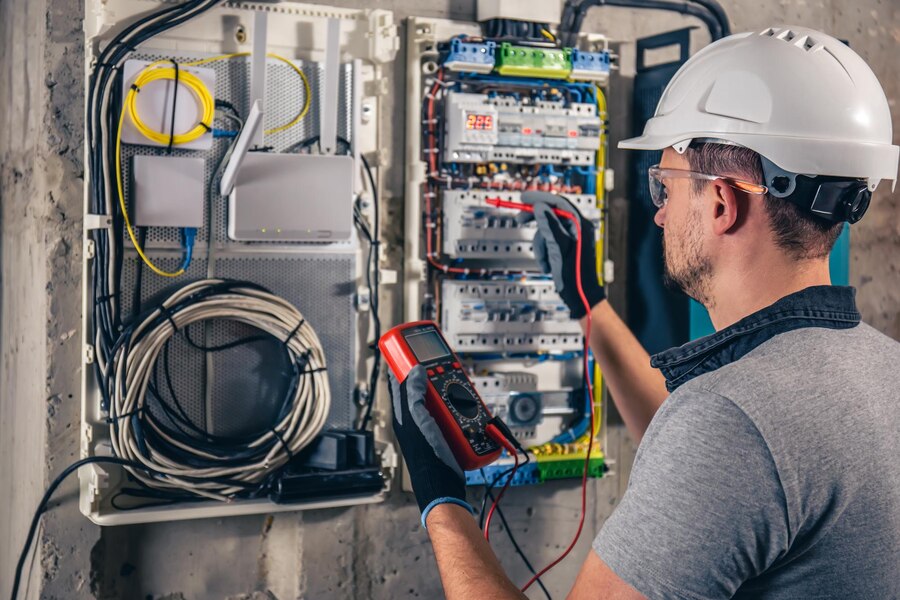
Electrical engineering is a vast and diverse discipline covering almost every area of our daily lives involving electricity. From designing city power grids to making circuit boards with tiny pieces that the human eye can barely see, electrical engineers are responsible for making the world go round. They are, quite literally, what powers the global economy.
What Are the Different Specializations of Electrical Engineering?
Electrical engineering is divided down into power, electronics, control systems, signal processing, and telecommunications engineering. Each of these groups breaks down into several subgroups of their own. To keep it brief, we’ll just cover these main areas.
Power Engineering
This field is concerned with generating power and how the power gets from point A to point B, also known as transmission. Without power engineers, our biggest and brightest cities would become dark each night, and we wouldn’t be able to exist in the modern comfort to which we’ve become so accustomed.
Some examples of power engineering are as follows:
Designing power generation plants such as nuclear or hydroelectric
Planning city electrical grids to ensure optimal distribution of power throughout a municipality
Drawing power wiring schematics for large industrial buildings
Designing battery and power systems for portable equipment
Electronics Engineering
This electrical engineering discipline focuses on the circuitry and power supply in many products we use daily. Major manufacturers worldwide employ thousands of electronics engineers to help design every conceivable electronic device you could imagine.
Here are a few examples we might see in the real world:
Designing circuit boards for a remote control
Designing plans for satellites
Ensuring circuit boards have adequate systems in place to process data as necessary
Microchip design and fabrication for use in everyday electronics
Control Systems Engineering
Control systems are pretty self-explanatory. These are the systems that control our lights, fans, air conditioning, security and fire alarms, and all manner of other systems that need constant monitoring or control. Below, you’ll find some examples of what a control systems engineer might do:
Designing thermostats for use in your home heating and cooling system
Working on boxes designed to act as the central hub of a building’s control systems
Validating that a data center has the correct power, air cooling, and fire alarm systems connected to a single control point where the manager can oversee everything
Signal Processing Engineering
A person wants to send a text message to a friend. How does the phone send the signal, and where does it go? How does the signal go to the correct phone and not the phone of a random guy nearby? Hello, signal processing!
Signal processing allows calls to be sent and received seamlessly without manually directing them. Some examples of signals processing engineering might be:
Writing algorithms to capture incoming signals and process them to determine their origin and destination
Programming artificial intelligence (AI) and other systems to route signals to their correct destinations
Designing systems to overcome difficulties in sending signals such as distance, storms, or intentional jamming by hostile entities
Planning encryption for seamless and secure end-to-end transmission of messages and signals around the world
Telecommunications Engineering
Telecommunications engineering is related to all the technology and infrastructure behind the scenes that allow the signals to travel to where they need to go to keep our digitally connected world moving.
Telecommunications engineers make it all possible, whether it’s a phone call to your grandmother or a text message to your best friend about your Saturday night plans.
Here are some things a telecommunications engineer might be doing on a day to day basis:
Antenna design and testing for radio-controlled devices
Designing receivers to capture and process the collected data
Microphone designs that filter out background noise so you can hear the speaker without being distracted by any ambient sounds
Working with satellite companies to enhance coverage and distribution of phone and internet services worldwide.
CANTER CADD being ISO 9001:2015 certified, the best CAD training institute can make a candidate’s profile strong and eligible to grab the trending jobs in the market. Moreover, the courses are offered by highly skilled and trained professionals to offer valuable knowledge to the candidates.
Locate CANTER CADD – The Best ansys Training Institute in Hyderabad-Mehdipatnam-Ameerpet-Himayatnagar-Dilsukhnagar-Habsiguda-Boduppal-ECIL-Santoshnagar-Chandanagar-Alwal-Kukatpally-Secunderabad-Warangal-Hanamkonda, Bangalore-Marathahalli-BTMLayout-Electronic City-Yelahanka-Banashankari-JPNagar-Srinagar-Hulimavu-Chamrajpet-Horamavu-Vidyaranyapuram, Andhra Pradesh-Guntur-Nellore-Kurnool-Rajahmundry-Tirupati-Dwarakanagar-Vizag-Vijayawada, Delhi NCR-LaxmiNagar-RajendraPlace-Rohini-Adhchini-Kalu-Sarai-, Pune-Akurdi, Tamil Nadu-Coimbatore, Uttar Pradesh--Gazhiabad-Meerut, Kerala, , Mumbai, Nagpur